Table of Contents
Toggle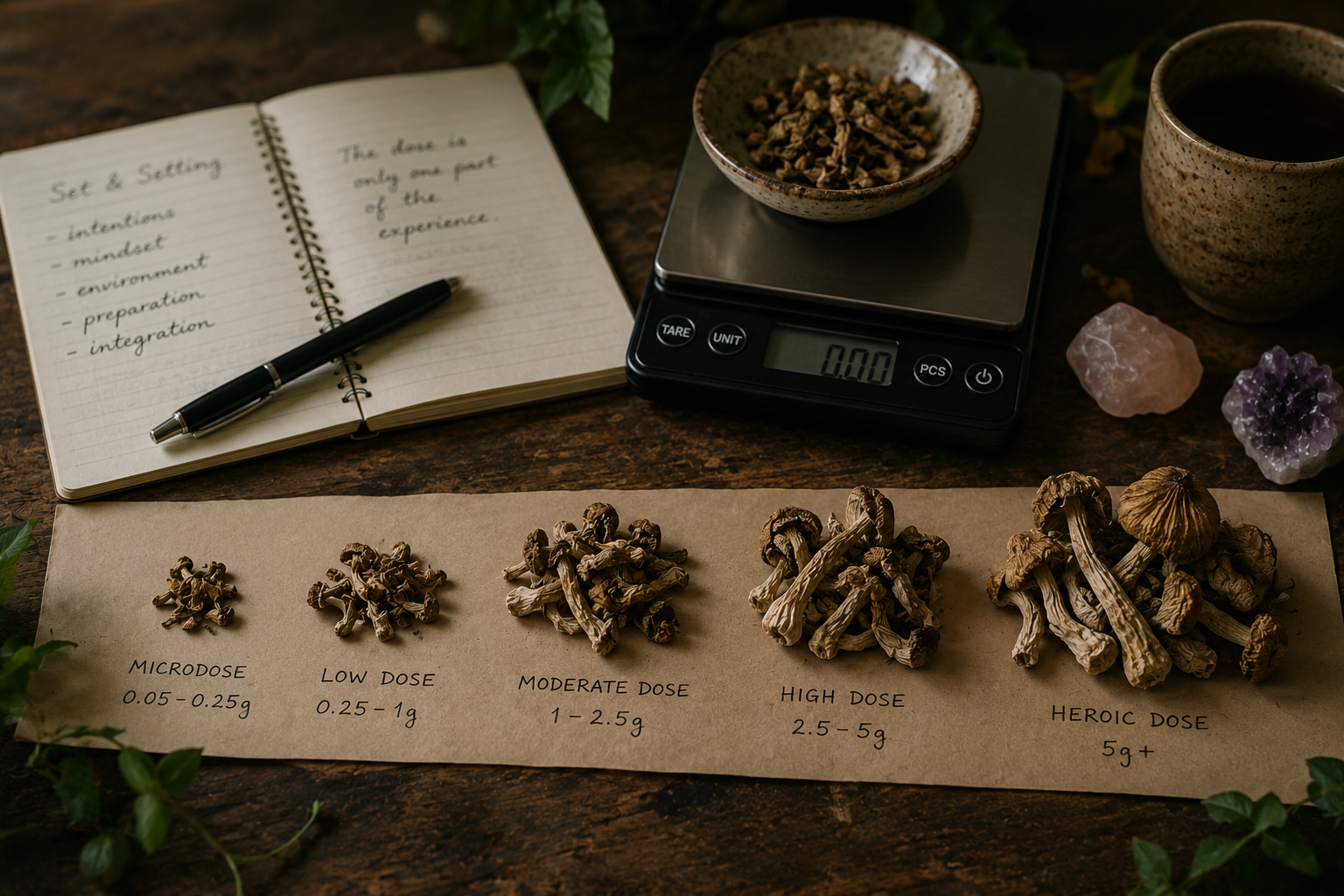
If you’ve spent any time around mushrooms, you’ve probably heard people talk about dosage as though there is a simple formula: “take this much and you’ll have this kind of experience.”
But friends, psilocybin doesn’t quite work that way.
Dose matters oftentimes profoundly but it is only one piece of a much larger picture. The same amount can feel subtle for one person and deeply immersive for another. As I mentioned in the Golden Teacher article a few weeks back I can take the exact same microdose as Mama Dose Co-founder Mark Medal, he’ll be able to breeze through our company meetings and I will have to disappear for a few hours to drop into a healing session. Not to mention that the mushroom itself can vary in potency.
Understanding psilocybin dosage, then, isn’t simply about knowing how much to take. It’s about understanding the relationship between dose, person, mushroom, and context.
Psilocybin experiences exist along a spectrum rather than in neat categories.
At lower doses, some people describe subtle changes in mood, sensory awareness, thought patterns, or emotional openness. Microdosing takes this idea even further, using amounts intended to remain below the threshold of a noticeable psychedelic experience.
As the dose increases, perceptual and psychological effects generally become more pronounced. Research in controlled settings has found that increasing psilocybin doses tend to increase the intensity of altered perception, mystical-type experiences, and aspects of ego dissolution.
At higher doses, the experience can become much more immersive. Ordinary boundaries of identity, time, space, and perception may soften dramatically. For some people this can feel beautiful, expansive, or deeply meaningful and for others, the same intensity can become frightening or overwhelming.
And this is an important distinction: more intense does not automatically mean more therapeutic, meaningful, or healing.
With some of the context above mentioned and the foundation laid for a broader scope of dosage, lets get into the basics. The chart below is intended as a general educational reference for dried Psilocybe cubensis mushrooms, not as a prescription or recommendation. There is no standardized mushroom dosage because the actual amount of psilocybin can vary substantially between mushrooms and batches.
|
Dose range |
Common description |
What someone might experience |
|
~0.05–0.25 g |
Microdose |
Usually intended to remain below the threshold of a noticeable psychedelic experience; subtle shifts in mood, attention, or sensory awareness may occur |
|
~0.25–0.75 g |
Very low / threshold |
Subtle but potentially noticeable changes in perception, mood, body sensations, or thought patterns |
|
~0.75–1.5 g |
Low |
More apparent sensory enhancement, emotional openness, altered thinking, and changes in perception |
|
~1.5–3 g |
Moderate |
Clear psychedelic effects; visual changes, altered sense of time, emotional intensification, introspection, and possible ego softening |
|
~3–5 g |
High |
Strong alterations in perception and consciousness; experiences may become highly immersive and psychologically challenging |
|
5 g+ |
Very high |
Potentially overwhelming intensity, profound alterations in identity and perception, and substantially increased need for a safe environment and experienced support |
*These ranges should not be treated as interchangeable with purified psilocybin. A clinical study using 25 mg of purified psilocybin cannot simply be translated into “X grams of mushrooms.” The chemical composition of mushrooms is too variable for that conversion to be reliable.
One of the most important things to understand about mushroom dosage is potency.
A gram is a measurement of mushroom material not a measurement of psilocybin.
Species, genetics, growing conditions, individual mushrooms, storage, and processing can all influence potency. This is one reason why two people can consume the same weight and report dramatically different experiences.
Microdosing research illustrates this problem particularly well. One controlled study using 0.5 g of dried Psilocybe cubensis found noticeable acute subjective effects but did not find evidence of improved creativity, cognition, or well-being, highlighting both the variability of the practice and the importance of separating anecdotal claims from controlled evidence.
In other words, the science is still developing and while it does- journey bravely but with caution and mindfulness. This section isnt to say the number on the scale doesn’t matter, but taking as many variables into account along with knowledge of the strain you’re taking will always prove to be beneficial.
There is another variable I haven’t mentioned yet that no scale can measure: you.
Your emotional state, expectations, physical energy, surroundings, and sense of safety can all influence a psychedelic experience. This is the foundation of the familiar psychedelic concept of set and setting.
A dose doesn’t happen in a vacuum.
The same person can have two very different experiences with the same amount because the circumstances surrounding those experiences have changed. This is one reason responsible psychedelic work considers preparation and environment alongside the substance itself.
It also means that increasing the dose isn’t always the answer when an experience feels subtle. Sometimes the more important variable is what’s happening around the experience or within us.
Psychedelic culture can sometimes create an unspoken hierarchy around intensity: the bigger the journey, the deeper the healing.
But that’s not necessarily true.
A profound experience doesn’t have to be the most visually intense experience. A gentle experience can reveal something important. A challenging experience can reveal something important. Clinical research has found therapeutic potential for higher-dose psilocybin in controlled settings, but these studies involve carefully screened participants, standardized psilocybin, preparation, supervision, and psychological support. Higher doses also bring greater potential for acute adverse effects.
For this psychedelic season of my life I’m toying with the concept of the most useful way to think about psilocybin dosage not as a number, but as a relationship.
The medicine meets your nervous system, your history, your expectations, your environment, and your intentions. Dose influences the intensity of that meeting, but it doesn’t determine what the experience will ultimately mean.
So alongside “How much?”, there are other questions worth asking:
Why am I doing this?
How am I feeling right now?
Do I feel physically and emotionally safe?
Do I understand the potency and uncertainty of what I’m taking?
Do I have support if the experience becomes difficult?
And perhaps most importantly:
What am I hoping to carry into my life afterward?
The dose may shape the doorway, but it doesn’t determine what happens on the other side.
What is revealed through the psychedelic experience is that the experiencer themselves functions as a unique keycode into how the experience and after effects unfold.
The blueprint is activated so to speak and the possibilities for change, healing and evolution heightened.
All grounds for a potent activation and transformation of relationship to many things including life itself.
Written by Wolfie.
Last updated: September 3, 2026.
Mama Dose publishes educational content about psilocybin and wellness practices. This article is not medical advice and has not been reviewed by a licensed medical professional.
Rewards
Invite your friends and earn a discount on your next purchase. Your friend also earns a discount! Get started now, by sharing your referral link with your friends.
This item is currently out of stock!
By adding it to your cart, you confirm a backorder purchase, and we will ship it as soon as it becomes available.