Psilocybin vs. Amanita muscaria: Two Mushrooms, Two Very Different Journeys
Not All Mushrooms Take Us to the Same Place
Mushrooms are truly fascinating organisms. Beyond their ecological roles in sustaining forests, recycling nutrients, and connecting entire ecosystems, as you may well know by now certain fungi contain compounds capable of profoundly altering human consciousness.
Our time here today will be spent looking at how not all psychoactive mushrooms work in the same way.
Specifically speaking, we’ll look at two of the most recognizable examples: Psilocybe mushrooms, which contain psilocybin, and Amanita muscaria, also known as the fly agaric.
Both have long histories of human interaction
Both can produce altered states of consciousness
Both have attracted renewed attention as interest in psychedelic and alternative medicines continues to grow.
Yet beneath their similarities lies a significant pharmacological difference.
Psilocybin and Amanita muscaria don’t simply offer different versions of the same experience. They interact with different neurotransmitter systems, produce different neurological effects, and carry different safety considerations.
Understanding these differences is important, particularly as products containing both mushrooms increasingly find their way into the wellness marketplace.
Let’s spend some time breaking down the science before getting into the nitty gritty.
Two Mushrooms, Two Different Chemistries

The most important distinction begins at the molecular level.
Psilocybin: The Serotonergic Pathway
Psilocybin, found in certain Psilocybe mushrooms, is converted in the body to psilocin. Psilocin interacts with serotonin receptors in the brain, mainly the 5-HT2A receptor, temporarily shifting how we process emotions, perceive the world, and experience ourselves.
Researchers have been particularly fascinated by its influence on the brain’s default mode network which is the system associated with our inner narrator, sense of identity, and habitual patterns of thought.
Think of psilocybin as temporarily turning down the volume on some of the stories we tell ourselves, which in the right circumstances creates room for new perspectives, unexpected connections, and a different way of seeing the world.
Amanita muscaria: The GABAergic Pathway
Amanita muscaria takes an entirely different route.
Amanita muscaria does not contain psilocybin. Its primary psychoactive compounds are muscimol and ibotenic acid.
These compounds interact with different neurotransmitter systems.
Muscimol acts primarily as a GABA-A receptor agonist. And if that makes no sense, just know that GABA is the brain’s principal inhibitory neurotransmitter. It helps regulate neuronal activity, reducing excessive excitation throughout the central nervous system.
Ibotenic acid, meanwhile, acts on glutamate receptors and can produce excitatory neurological effects.
Interestingly, ibotenic acid can also convert into muscimol through a process called decarboxylation.
The combination of these compounds helps explain why Amanita muscaria can produce such an unusual range of effects, including sedation, confusion, altered perception, agitation, involuntary movements, and delirium.
While psilocybin primarily engages the serotonergic system associated with classic psychedelic experiences, Amanita muscaria acts through mechanisms more closely associated with nervous system excitation and inhibition.
This distinction fundamentally changes the nature of the experience.
What Does Each Experience Feel Like? Psilocybin vs. Amanita muscaria
Although individual experiences vary considerably, the differences in pharmacology provide some insight into the contrasting subjective effects.
The Psilocybin Experience and Its Effects
Psilocybin is commonly associated with what researchers classify as a classic psychedelic experience.
Depending on the individual, environment, amount consumed, and psychological context, experiences may include:
Enhanced visual perception, including geometric patterns and intensified colors.
Heightened emotional awareness and sensitivity.
Changes in the perception of time.
Increased introspection and autobiographical reflection.
A temporary loosening of habitual thought patterns.
Experiences of interconnectedness, unity, or transcendence.
Profound emotional experiences that may include grief, fear, joy, or awe.
One of the most interesting areas of psilocybin research is its potential to interrupt deeply ingrained patterns of thinking.
This temporary flexibility, combined with psychological support and integration, has been shown time and time again to greatly assist people approach longstanding emotional and behavioral patterns from a different perspective.
It is important to recognize that these experiences are not always comfortable or positive. Anxiety, fear, confusion, and psychological distress can also occur.
The Amanita muscaria Experience and Its Effects
If psilocybin works through altering the doors of perception, Amanita works through altering somatic perception one could say.
Often described as dreamlike, earthy, and deeply embodied, Amanita muscaria offers a very different subjective experience from psilocybin.
Rather than the heightened sensory perception and introspective depth commonly associated with psilocybin, Amanita is often associated with:
A sense of physical relaxation and ease.
Dreamlike imagery and unusual sensory experiences.
Shifts in body awareness and spatial perception.
A floating, surreal, or sleep-like quality.
Changes in mood, awareness, and perception.
Drowsiness and altered levels of consciousness.
Confusion and disorientation (at higher doses)
Experiences vary widely, but this contrast is what makes the two mushrooms so interesting: different pathways, different experiences, and different relationships with consciousness.
Therapeutic Potential: What Does the Research Actually Say?
This is where the distinction becomes especially important.
Psilocybin has become one of the most extensively investigated naturally occurring psychedelic compounds in contemporary psychiatric research.
Clinical trials have explored its potential applications in depression, anxiety associated with serious illness, substance use disorders, and other mental health conditions.
Some studies have produced promising results- particularly when psilocybin is administered in carefully controlled settings alongside psychological support- including changes in neural connectivity, emotional processing, cognitive flexibility, and the capacity to approach difficult experiences differently.
Amanita muscaria, on the other hand, has a much smaller body of clinical research.
Muscimol has been studied for its effects on GABA receptors, and researchers have investigated its neurological properties. However, there is currently insufficient clinical evidence to establish Amanita muscaria as a safe or effective treatment for depression, anxiety, trauma, or other mental health conditions.
This distinction matters. However if you’ve read my piece on Medicalizing the Mystical you’re well aware that just because a medicine hasnt been studied of declared safe or worthy by modern research doesnt rule it out. Especially when there is a documented rich and colorful history with a substance.
Ancient Relationships and Modern Interpretations

Long before psychedelic research laboratories and wellness storefronts, humans were developing relationships with psychoactive fungi that extended into spirituality, healing, and the mysteries of consciousness.
Beyond their chemistry, both mushrooms have attracted cultural and historical interest.
Psilocybin-containing mushrooms have documented histories of ceremonial and spiritual use, particularly among Indigenous communities in Mesoamerica. These relationships extend beyond the pharmacological effects of the mushroom and involve traditions of healing, divination, community, and spiritual practice.
Amanita muscaria also has a long history of human interaction, particularly across parts of northern Eurasia and Siberia, where ethnographic accounts document ceremonial and ritual uses among certain Indigenous communities.
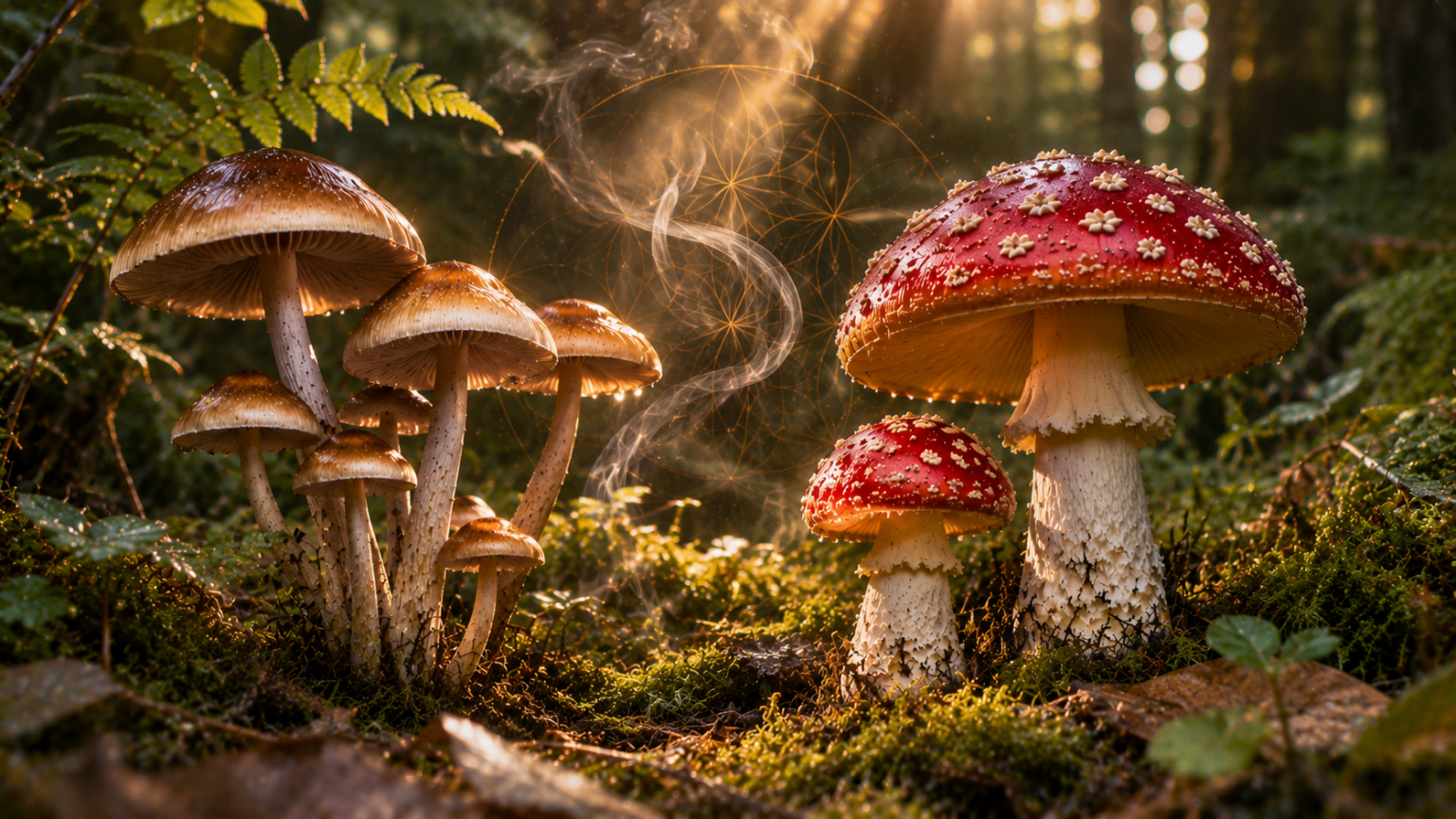
Its striking red cap and white spots have made it one of the most recognizable mushrooms in the world. It has also become deeply embedded in folklore, art, and popular imagination.
There are numerous theories about Amanita muscaria’s historical and religious significance, we won’t go down the rabbit hole although it is quite an interesting one.
What is worth recognizing is that neither mushroom exists solely as a collection of psychoactive compounds. Human relationships with fungi have developed through ecological knowledge, cultural practices, spiritual traditions, and generations of observation.
We can appreciate these cultural relationships while remaining discerning about safety and what modern science has and has not established.
Why the Distinction Matters in Today’s Mushroom Market

As interest in functional mushrooms, psychedelics, and alternative wellness products continues to grow, the word mushroom has become an increasingly broad marketing category.
Products containing psilocybin, Amanita muscaria, lion’s mane, reishi, and other fungi are sometimes grouped together under the same umbrella despite having dramatically different chemical compositions and physiological effects.
This can create confusion, especially for people who are new to working with mushrooms.
Amanita muscaria gummies, for example, are sometimes marketed as legal alternatives to psilocybin products. But legal availability does not establish safety, and a different legal classification does not mean a substance offers a comparable experience.
It is equally important to distinguish between functional mushrooms and psychoactive mushrooms.
Lion’s mane and Reishi are generally explored for their non-intoxicating biological properties. Psilocybin and Amanita muscaria contain compounds that directly alter neurological functioning.
These are fundamentally different categories of fungi, and they deserve to be understood as such.
For consumers, walkers of the medicine path and informed humans in general, this means looking beyond marketing language. Understanding the actual compounds in a product, the quality of available research/ history, and the potential risks is far more important than whether something is described as natural, ancient, legal, or plant-based.
Two Mushrooms, Two Very Different Conversations
As we come to a close on this weeks exploration, it seems that a valuable lesson in comparing psilocybin vs. Amanita muscaria and looking at an even bigger picture is that nature does not operate according to the categories we create for it.
Two mushrooms can both alter consciousness while doing so through entirely different biological pathways.
One has captured the attention of modern neuroscience for its potential to reshape our understanding of consciousness and mental health. The other remains a fascinating, less-explored corner of the fungal kingdom, with much still to discover about its chemistry, effects, and potential.
Neither should be approached casually, and neither is without risk.
As our understanding of fungi continues to evolve, it is worth maintaining a balance between curiosity and discernment.
There is extraordinary potential within the fungal kingdom, but not every mushroom that changes consciousness is medicine, and not every naturally occurring compound is inherently safe.
The more we learn about fungi, the more important it becomes to understand them on their own terms.