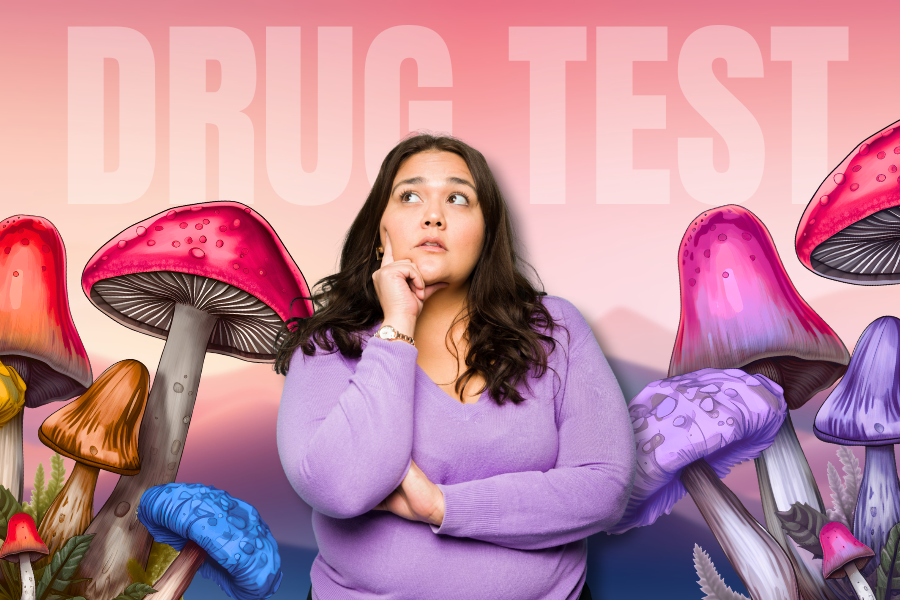
There’s a particular kind of anxiety that blooms quietly in the back of the mind. It shows up after a weekend in the woods, or a long, inward-looking night, right around the moment someone remembers a looming drug test. The question arrives half-formed. Does psilocybin show up? Does it stick around? Did that one decision ripple further than expected?
The short answer is reassuring. The longer answer is more interesting.
Psilocybin, the naturally occurring compound found in certain mushrooms, is famously slippery when it comes to drug testing. It moves through the body quickly, leaves a light footprint, and rarely appears on standard panels. But “rarely” isn’t the same as “never,” and understanding the nuance matters, especially in a culture where testing often says more about control than care.
This is a look at what actually happens inside the body, how drug tests work, and why psilocybin occupies such a strange, almost ghostlike position in the toxicology world.
Psilocybin itself doesn’t hang around for long. Once ingested, it’s rapidly converted by the liver into psilocin, the compound responsible for altered perception, emotional fluidity, and that sense that the trees might be listening a little more closely than usual.
Psilocin is the biologically active compound. It interacts with serotonin receptors, especially 5-HT2A, then gets metabolized and excreted. No storage. No buildup. No quiet accumulation over time.
That got researchers thinking decades ago. If the compound acts quickly and exits just as fast, what exactly would a drug test be looking for?
The answer is. Not much.
Most workplace and probation drug tests rely on standardized panels. These panels are designed to detect substances that are commonly abused, widely distributed, and chemically stable enough to linger. Substances like cannabis metabolites, cocaine byproducts, opioids, and amphetamines are more frequently screened.
Psilocybin doesn’t fit that profile.
Testing for it requires specialized equipment, targeted assays, and a reason to look in the first place. It’s not part of the typical five-panel or ten-panel screens. It’s not even an afterthought. It’s more like a footnote.
In practice, that means psilocybin is very unlikely to show up unless a test is specifically designed to detect psilocin. Those tests exist, mostly in research or forensic settings, but they’re rare and expensive.
Which brings us to the timelines.
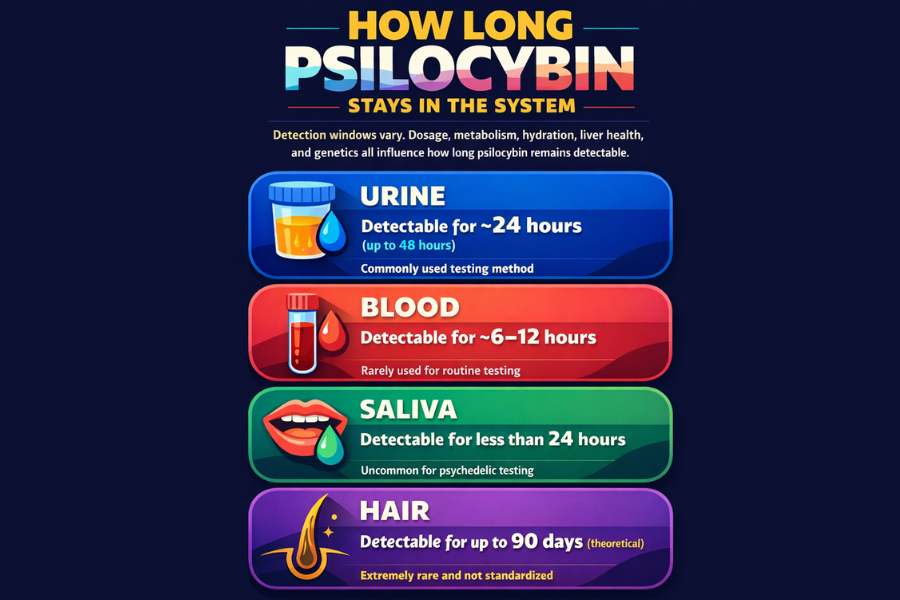
Detection windows aren’t exact. Bodies differ. Metabolism varies. Dosage, frequency, liver health, hydration, and even genetics play a role. Still, research and clinical data offer some reasonable estimates.
Psilocin is typically detectable in urine for about 24 hours. In some cases, especially with higher doses, traces may persist up to 48 hours. After that, levels drop below detectable thresholds.
Blood testing has a much narrower window. Psilocin generally remains detectable for about 6 to 12 hours. Beyond that, it’s usually gone, metabolized into inactive compounds.
Saliva tests are uncommon for psychedelics, but if used, psilocin would likely be detectable for less than 24 hours.
This is where things get weird, at least in theory. Hair tests can reflect drug exposure over a period of up to 90 days. However, hair testing for psilocybin is extremely rare. There’s little standardization, limited demand, and significant challenges in distinguishing meaningful exposure from environmental contamination.
So yes, it’s possible in theory. In reality, it almost never happens.
There’s a persistent belief that psychedelics “stay in the system” in some undefined, quasi-mystical way. That they lodge themselves in the spinal fluid. That they resurface years later. That one trip means permanent chemical fingerprints.
Science doesn’t support that.
What does linger isn’t the molecule. It’s the memory. The insight. The emotional afterimage. A sentence overheard during a ceremony that refuses to fade. A moment of clarity that changes how someone listens to their own thoughts.
Drug tests don’t measure any of that. They measure metabolites, not meaning.
Another common worry involves false positives. Could psilocybin trigger a result for something else?
The consensus is no. Psilocybin and psilocin have distinct chemical structures that don’t resemble the substances typically screened for. There’s no credible evidence suggesting psilocybin causes false positives for LSD, amphetamines, or other drugs.
That said, drug testing isn’t a perfect science. Lab errors happen. Samples get mishandled. Context gets lost. Which is why understanding the limitations of testing is just as important as understanding the chemistry.
Here’s the uncomfortable part. Drug tests are often framed as tools for safety or wellness, but they’re usually about compliance. About liability. About power.
Psilocybin’s near invisibility within these systems exposes something awkward. A substance with a long history of ceremonial use, a growing body of therapeutic research, and a remarkably low toxicity profile is treated as illicit, while substances with far greater harm profiles are legally prescribed and easily detected. That contradiction doesn’t resolve itself in a lab report.
Understanding detection windows isn’t about gaming the system. It’s about reducing unnecessary fear and misinformation. People deserve accurate information about what they put in their bodies and how institutions respond to it. Especially when those institutions aren’t always transparent about their own motives.
Psilocybin leaves the body quickly. It doesn’t accumulate. It doesn’t announce itself loudly in standard tests. But it still deserves respect. Set, setting, mental health, legal context. All of it matters. No test can measure intention. Or readiness. Or whether someone walked away gentler than they arrived.
As psychedelic research continues to move out of the shadows and into universities, clinics, and public conversation, questions like this will keep surfacing. Not because people are reckless, but because the rules are lagging behind reality.
Psilocybin’s relationship with drug testing reveals a system built for a different era. One that struggles to categorize substances that don’t behave like the rest. One that’s far more comfortable measuring residues than grappling with consciousness.
Maybe that’s the quiet lesson here.
Some things pass through quickly. Others stay with you, undetectable, shaping how the world feels long after the chemistry has cleared.
And no cup, swab, or strand of hair can tell that story.