Table of Contents
Toggle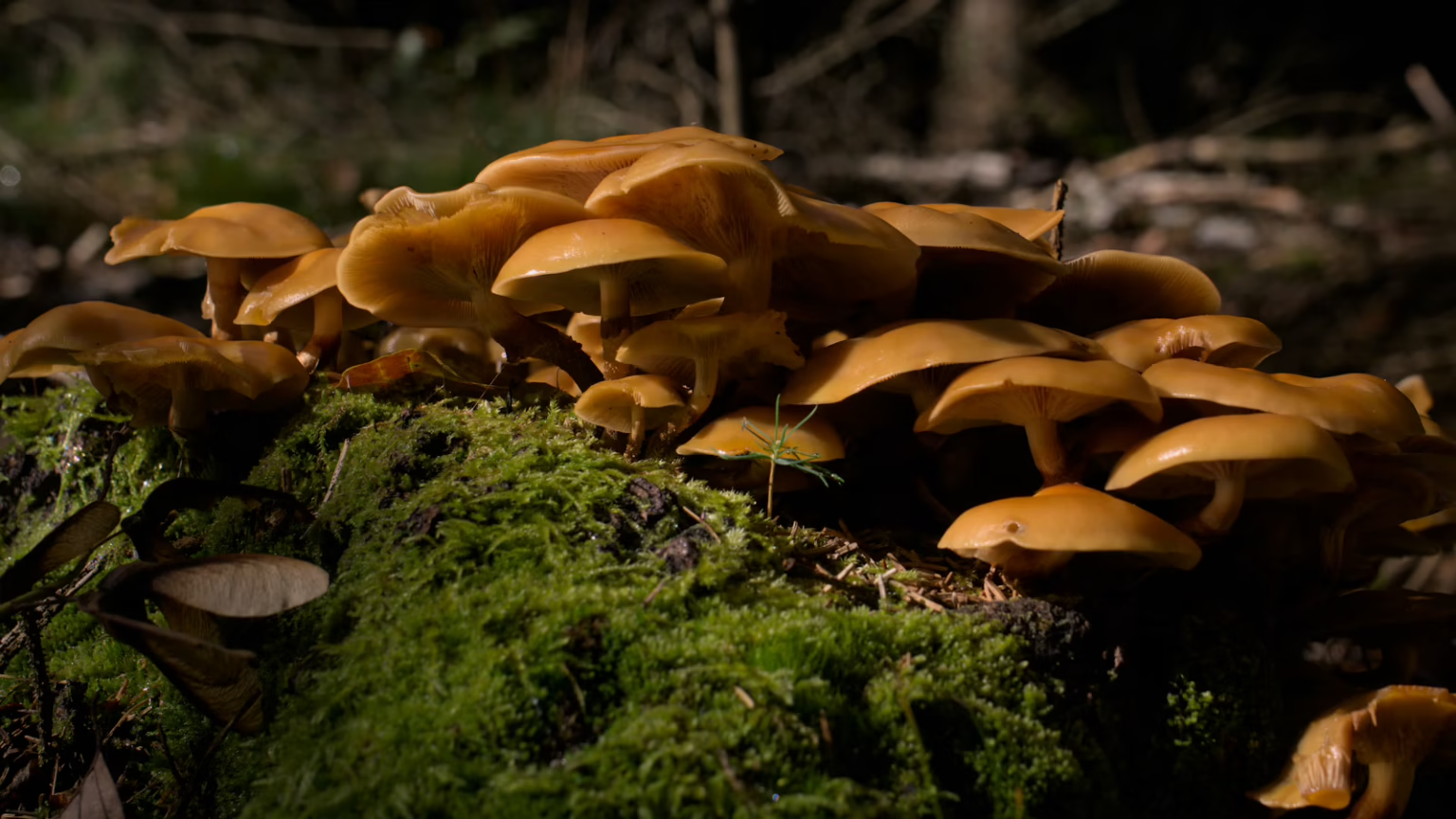
“If you die before you die, you won’t die when you die.”
— Brian C. Muraresku, The Immortality Key
Before entering into this week’s blog, I invite you to pause and take notice of how the title landed in your body. What emotions, sensations, memories or feelings if any did the title of this essay stir in you?
Whatever comes up can be a powerful place of inquiry for you. Isn’t it ironic how taboo one of the only things we all experience throughout our lives and will ultimately all face upon exit is in the western culture? As it would seem, taboo begets taboo and so while mushrooms are for reasons beyond our control seen as taboo by many in the wider web, they serve as a great doorway into the next. Death.
The phrase “dying before we die” points to an ancient mystical idea: that we can undergo a symbolic death while still alive. That is, a temporary dissolution of the ordinary self that radically changes our relationship with mortality.
In The Immortality Key, Brian Muraresku investigates evidence suggesting that ancient Greek and Mediterranean mystery traditions may have used psychoactive substances within ritual contexts to induce experiences of transcendence and perhaps provide initiates with a direct encounter with death and the possibility of something beyond it.
Mushrooms offer a particularly powerful lens through which to explore this idea. A mushroom literally emerges from death and decay. It feeds on what has broken down, transforming decomposition into new life. Psychedelic mushrooms can similarly be understood as an encounter with dissolution: the loosening of identity, the destabilization of our ordinary boundaries, and, as some of you may know, at higher doses, the experience sometimes described as ego death.
In the weeks before, we explored the process of aging, ripening, coming deeper and deeper into the lived experience of one’s own being through both a philosophical and scientific lens. And now we arrive at this inquiry:
What if confronting death is part of learning how to live?
Across mystical traditions, initiation often involves some form of descent, dismemberment, dissolution, or symbolic death before rebirth. Muraresku’s exploration of the ancient mysteries raises the possibility that altered states were not simply recreational experiences, but technologies for confronting one of the deepest human mysteries:
What happens when the self we think we are temporarily disappears?
The mushroom becomes an almost perfect metaphor and potentially a sacramental participant in this process. It teaches through its own life cycle: to become something new, something must first break down.
For the first year of my apprenticeship in the arts of mysticism and plant medicine, I decided to study death. Death was introduced to us as a master teacher.
Much was revealed throughout this journey, but perhaps the most striking was this: through the act of walking for several months with death as a master teacher, I was invited more deeply into life.
Instead of putting death off to a distant, hopefully never-arriving future, out of sight and mind, it was invited to the forefront of our consciousness to discuss, explore, and come into relationship with.
The choice to investigate and confront death while we’re still alive opens many doors that we aren’t necessarily taught or encouraged to open.
And this is where I believe psychedelic experiences can become particularly profound.
These experiences can show us things about our own mortality, but they can also give us an opportunity to practice surrender to loosen our grip on identity, control, certainty, and the stories we have constructed about who we are.
Sometimes what dies is not the body, but an old version of ourselves.
An identity.
A belief.
A relationship to the world.
A way of being that has already served its purpose.
Perhaps this is part of what the ancient mystery traditions understood: that there are forms of death we can encounter before our physical death, and that moving consciously through these thresholds can change the way we inhabit our lives.
And perhaps this is also why psychedelic experiences can open conversations about death with others.
When we have allowed ourselves to look directly at our own mortality, death can become less of an unspeakable abstraction and more of something we can sit beside. We may become more willing to ask the questions that so often remain hidden:
What am I afraid of losing?
What am I holding onto?
What would I do differently if I truly understood that my time here is finite?
How would I live if I stopped treating death as something that happens only at the end of life?
We don’t know what happens after death. And I don’t think psychedelics can give us a definitive answer.
Instead, they can give way to an experience that makes the question impossible to ignore.
The mushroom does not necessarily offer us an escape from death. Perhaps it offers us a relationship with it.
It emerges from what has broken down. It transforms decay into life. And in certain experiences, it can invite us to let something within ourselves dissolve so that we can return with a different relationship to who we are.
Maybe this is what it means to die before we die.
To explore all of the ways we might become intimate with impermanence.
Rewards
Invite your friends and earn a discount on your next purchase. Your friend also earns a discount! Get started now, by sharing your referral link with your friends.
This item is currently out of stock!
By adding it to your cart, you confirm a backorder purchase, and we will ship it as soon as it becomes available.