The Wisdom Beneath Our Feet: What Mycelium Teaches Us About Connection
There is an entire world beneath our feet that most of us will never see. (Along with multiple realms inside and outside of us composed of microbiome environments, energetic fields, unperceivable beings and radio waves but I digress). Let’s take a moment to let that statement sink in.
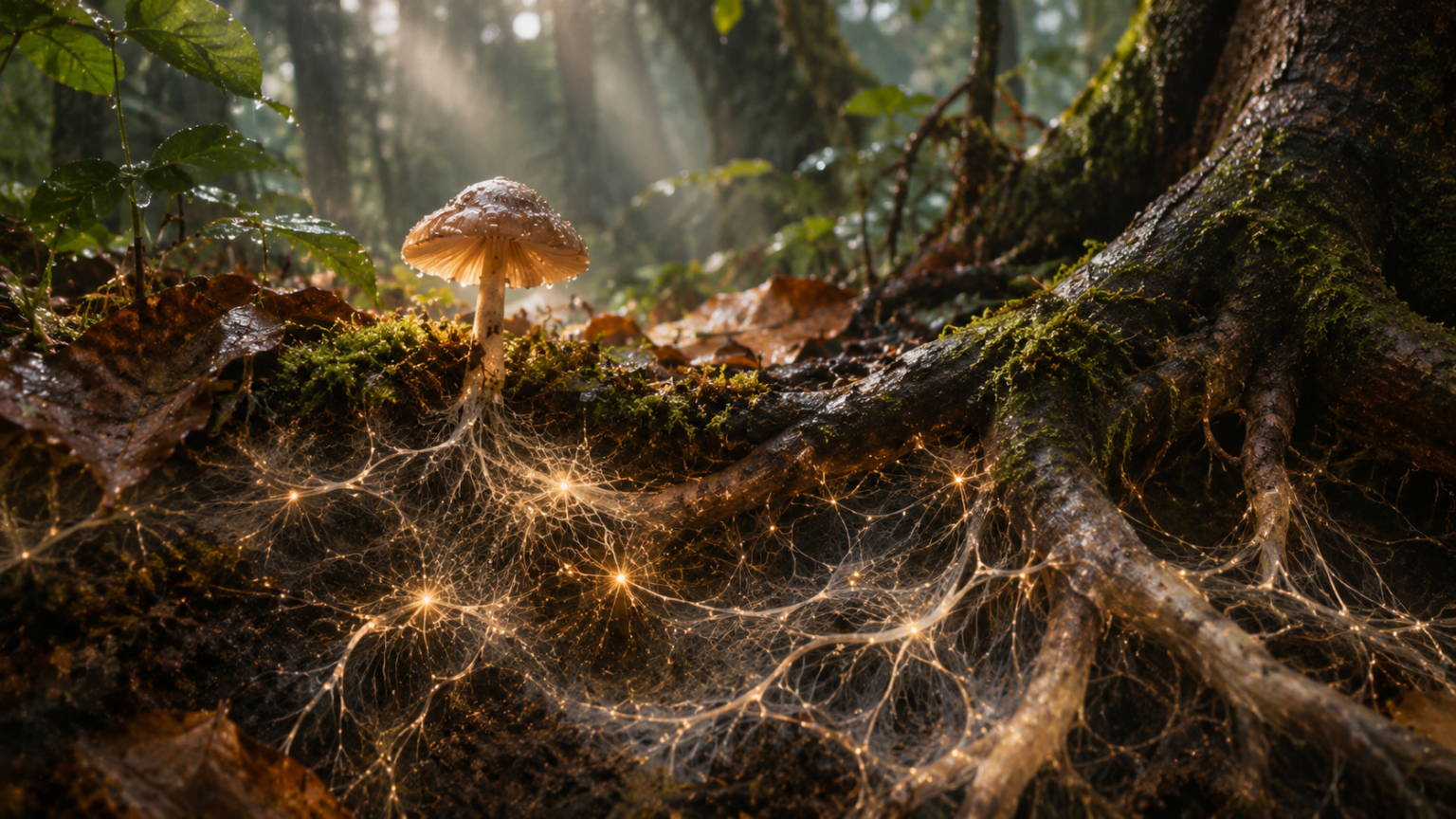
Under the forest floor, beneath fallen leaves and decaying wood, fungal networks are constantly growing and changing. Fine, threadlike structures called hyphae extend through the soil, branching, meeting, separating, and sometimes fusing together to form what we know as mycelium. These networks are responsible for far more than the mushrooms we occasionally find pushing through the earth. They participate in the exchange of nutrients, the decomposition of organic matter, the formation of soil, and the relationships that allow countless other organisms to survive.
It is easy to walk through a forest and see individual trees, each one appearing to exist on its own. We recognize their trunks, branches, leaves, and roots and we rarely consider the vast living systems beneath them, or the relationships that make the forest possible.
The more we learn about fungi, the harder it becomes to understand life as a collection of separate, self-sufficient beings.
And for the purposes of this exploration, that is where the deeper lesson begins.
A world built through relationship

For a long time, much of our understanding of the natural world has been shaped by the individual organism. We study the tree, the animal, the human body, and the individual species. We identify boundaries, isolate variables, and try to understand how each part functions independently.
There is tremendous value in this way of seeing. But it can also leave us with an incomplete picture.
The more life that I experience the clearer it becomes that life does not unfold in isolation. Every organism exists within a web of relationships, shaped by exchanges and dependencies that often extend far beyond what is immediately visible.
Consider the relationship between fungi and plants. Mycorrhizal fungi grow in association with plant roots, extending their reach into the soil and helping plants access nutrients. In return, plants provide fungi with carbon compounds produced through photosynthesis. This is an exchange that has helped shape terrestrial ecosystems for hundreds of millions of years.
The scale of this relationship is difficult to comprehend.
A 2026 study published in Science, drawing on more than 16,000 soil cores across nine biomes, estimated that the world’s topsoil contains approximately 1.1 × 10¹⁷ kilometers of living hyphae from arbuscular mycorrhizal fungi. And if that didn’t register I’ll put it like this. The estimated biomass of these networks is several times greater than the total biomass of humanity.
Think about that for a moment. Beneath the surface of the ground is a living infrastructure of almost unimaginable scale, humbly participating in the conditions that make life possible.
Biologist Merlin Sheldrake explores this extraordinary fungal world in his book Entangled Life. In an interview with Atmos, he offers a description that feels particularly relevant to the way we understand ourselves:
“We’re less collections of matter and more systems through which matter is passing.”
It is a striking way to consider the living world. Our bodies, too, are in constant exchange with their surroundings. Matter moves through us, relationships sustain us, and the boundaries we draw around individual organisms become more complicated the closer we look.
Sheldrake’s work and looking to nature as our teacher invites us to reconsider some of our most familiar assumptions about individuality, intelligence, and the boundaries between organisms. Fungi demonstrate that complex coordination does not always require a central command center, and that relationships between different forms of life can produce capacities that neither could achieve alone.
The forest, in this sense, is not simply a gathering of trees. It is a living community of exchanges, dependencies, competition, cooperation, and constant transformation.
The illusion of separateness

This way of understanding the natural world brings us into conversation with a much larger philosophical question: What if separateness is not the fundamental condition of existence?
This question of separateness has been contemplated for thousands of years, particularly within Buddhist philosophy. Through the teachings of dependent origination and emptiness, Buddhism offers a radically different understanding of existence: nothing arises or exists entirely on its own. Everything is shaped by the conditions, relationships, and countless interdependencies that allow it to be. What we perceive as separate and self-contained is, in reality, part of a much larger web of becoming. This understanding finds a contemporary expression in the work of systems scientist Dr. Alexander Laszlo who I had the great pleasure of meeting and studying with over the course of 4 modules in October.
Systems scientist Dr. Alexander Laszlo has spent much of his work exploring interbeing, collective intelligence, and the ways living systems emerge through relationships. He describes a progression that captures this beautifully: “From being to interbeing to interbecoming.”
It is a movement away from understanding ourselves as isolated individuals and toward recognizing the larger systems of which we are unique expressions. We are shaped, molded and refined through our relationships, continually influencing and being influenced by the world around us.
This idea finds a powerful companion in the work of Bayo Akomolafe, (my favorite philosopher and gift to the modern day world) whose writing challenges the boundaries we draw between human and nature, self and other, and the individual and the world.
In his essay How Do We Respond to Crisis?, Akomolafe writes:
“The world is not made up of things, it is made of relationships.”
He goes on to explore the possibility that relationships precede the things we understand as separate entities. Rather than imagining that independent beings exist first and enter into relationship afterward, he invites us to consider that relationship is fundamental to how things come into being.
It is a profound shift in perspective.
We tend to think of ourselves as individuals who then form relationships with the world. We have relationships with our families, communities, environments, and the natural world. But what if these relationships are not simply additions to who we are? What if they are part of what makes us who we are in the first place?
Our bodies are the first expression of this entanglement we come to know. We breathe air produced through the activity of other living organisms. Our gut is home to vast microbial communities. The food that becomes our bodies comes from an intricate chain of relationships between soil, fungi, plants, animals, water, sunlight, and countless other forms of life. Even the thoughts we consider uniquely our own have been shaped by language, culture, ancestry, and the people whose lives have intersected with ours.
Dear reader, we are not standing outside of nature, observing it from a distance. We are nature, participating in its ongoing becoming. I explored this sense of belonging in Mushrooms and Our Relationship with Nature.
Fungal intelligence without a center

One of the most fascinating qualities of mycelium is the way it organizes itself.
Unlike organisms with centralized nervous systems, fungal networks do not have a brain directing their activity. Their growth and responses emerge through countless local interactions across the network. Hyphae explore their surroundings, respond to available resources, navigate obstacles, and adapt to changing conditions.
This challenges some of our assumptions about intelligence. We have become accustomed to associating intelligence with a brain, a central authority, or a clearly identifiable decision-maker. Fungi as a teacher invites us to consider forms of coordination that are distributed, responsive, and deeply embedded in an organism’s relationship with its environment.
Sheldrake has spoken about how fungi challenge our ideas of individuality, too. In an interview with BBC Science Focus, he reflects on the ability of fungal networks to fuse with other networks, forming larger interconnected structures. He asks a deceptively simple question: Where does one begin, and where does one end?
It is a question that extends well beyond the fungal kingdom.
There is something compelling about this when we consider the systems we build as human beings. So much of our social world is organized around hierarchy, control, competition, and the pursuit of individual success. We are taught to distinguish ourselves, protect our own interests, and measure our worth through what we can accomplish independently. Even our language of growth often centers on the individual: self-improvement, self-sufficiency, personal achievement.
Yet the natural world offers countless examples of another kind of strength. A strength that emerges through interdependence. Through responsiveness. Through the capacity to participate in something larger than oneself.
Yet this does not mean that fungal networks are perfect models of harmony. The fungal world contains competition, exploitation, and conflict, too. Nature is not a sentimental picture of universal cooperation. Its relationships are dynamic, negotiated, and sometimes destructive. But that complexity makes the lesson more meaningful, not less. Connection does not require everything to be the same, or every relationship to be mutually beneficial. It asks us to recognize that life is shaped through ongoing relationships, whether or not they are comfortable or harmonious.
Reciprocity in mycorrhizal networks
Finally, one of the most important lessons we can draw from mycelium is the role of exchange.
In mycorrhizal relationships, plants and fungi exchange resources in ways that can benefit both partners. These relationships are not simply acts of generosity. They are shaped by ecological conditions, availability, demand, and the needs of the organisms involved. Research into these networks continues to reveal just how complex and context-dependent these exchanges can be.
Still, there is something worth contemplating in the basic arrangement: life is sustained through relationships of giving and receiving.
Forest ecologist Suzanne Simard has spent decades studying the relationships between trees and the fungal networks that connect their roots. Her research has helped reveal how these underground associations can influence the movement of resources and the regeneration of forest ecosystems.
In Finding the Mother Tree, she offers a beautiful reflection:
“There is no moment too small in the world. Nothing should be lost. Everything has a purpose, and everything is in need of care.”
Her words bring a human dimension to the science. They remind us that the relationships sustaining a forest are not only a matter of ecological function; they can also invite us to reconsider our own relationship with the living world.
We often speak about reciprocity as a moral ideal, something we should practice in our relationships with other people. But in the natural world, exchange is not merely an ethical preference. It is woven into the conditions of survival. Organisms depend on one another in ways that are often invisible, and the health of a larger system is shaped by the quality and diversity of its relationships.
What might change if we began to understand our own lives through this lens?
Belonging less about finding a place where we fit, and more about recognizing the relationships through which we are already being shaped? Community understood not as a collection of individuals sharing space, but as a living network of mutual influence, responsibility, and exchange?
This perspective asks us to recognize our interdependence in that our actions do not end with us. The way we consume, build, extract, care, and relate has consequences that move through systems far beyond our immediate awareness.
Akomolafe’s writing is particularly useful here because he does not allow relationality to become a comforting metaphor for universal togetherness. To understand ourselves as entangled with the world is also to consider our participation in its suffering, its inequalities, and its ongoing transformation. Relationship brings responsibility with it.
We are implicated in the world we inhabit. We are continually shaping it, even when we do not recognize the ways we are doing so.
Learning to see what has always been there
The visible world is only part of the story, a theme I returned to in When the Sacred Becomes Ordinary. Beneath the surface, relationships are unfolding that sustain, transform, and connect the living world in ways we are only beginning to understand. The mushroom that appears after rain is simply one brief expression of a much larger organism. What we see is not the whole.
There is something humbling about this. It reminds us how much of existence takes place beyond our perception, beyond our language, and beyond the frameworks we use to make sense of the world.
For me, this is where the scientific wonder of mycelium begins to touch something more philosophical, even spiritual. There’s room for both the research and the mystery it opens up. The study of these networks offers tangible evidence of interdependence, while also opening a much larger inquiry into what it means to exist in relationship. It invites us to look again at the boundaries we draw around ourselves and to consider how much of life is made possible through connections we may never fully see.
Again, I invite you to peer through and experience life from the lens in which we are not separate observers of a living world but participants in it. Our lives are woven into relationships with other people, other species, the land beneath us, and the generations that came before us.
The mycelium has been there all along, quietly doing its work beneath the surface inviting us to become more attentive to the networks that sustain us, and to remember that the story of any one life has never belonged to that life alone.